Hávamál 136 and the Case for Norse Animism
DOI: 10.17613/e3mne-v3852
I think the possibility that the Old Norse people believed there was life in things other than themselves is still under debate. It sometimes seems the primary texts hand us crystal-clear examples in plain sight, but caution keeps us from making assumptions. Even so, animism never actually left us. We still name our cars. We name our ships. We grew up on stories where household objects come alive in Disney movies. We simply forgot that we’re not the only living beings in the universe and began to put ourselves in the center, where we don’t belong. (Hint: We don’t belong at the bottom either.)
I realize that for those getting used to idea their phone has a spirit and may become a spirit, it can take a conscious effort to acknowledge this. I hope after a while you get used to it enough you don’t think about it, unless something comes up like when it comes time to dispose of your phone – there are things you do for beloved items, you see.
To see some casual.. I wouldn’t say automatic, but definitely the way of thinking as an automatic-background-hum animism in action, we just have to look at Hávamál 136. I’ll give the text and three separate translations:
| Hávamál 136 | Translation |
|---|---|
| Rammt er þat tré er ríða skal ǫllum at upploki; baug þú gef, eða þat biðja mun þér læs hvers á liðu. (Pettit, Poetic Edda Dual Language Edition, p. 110) | (Jackson Crawford, The Poetic Edda Expanded Edition, 2025, p. 49)1 It’s a strong door that out to open to let everyone in. Give a visitor something, or he will call every curse down on your limbs. |
| (My bad attempt at translation) Strong is that tree (wooden beam) that must ride for all unlocked; ring you give, else that (beam) may bid hollows to all of your joints. | (Pettit translation, p. 111)2 Strong is the beam that must slide to open up for all; give an arm-ring, or visitors will invoke every kind of injury upon your limbs. |
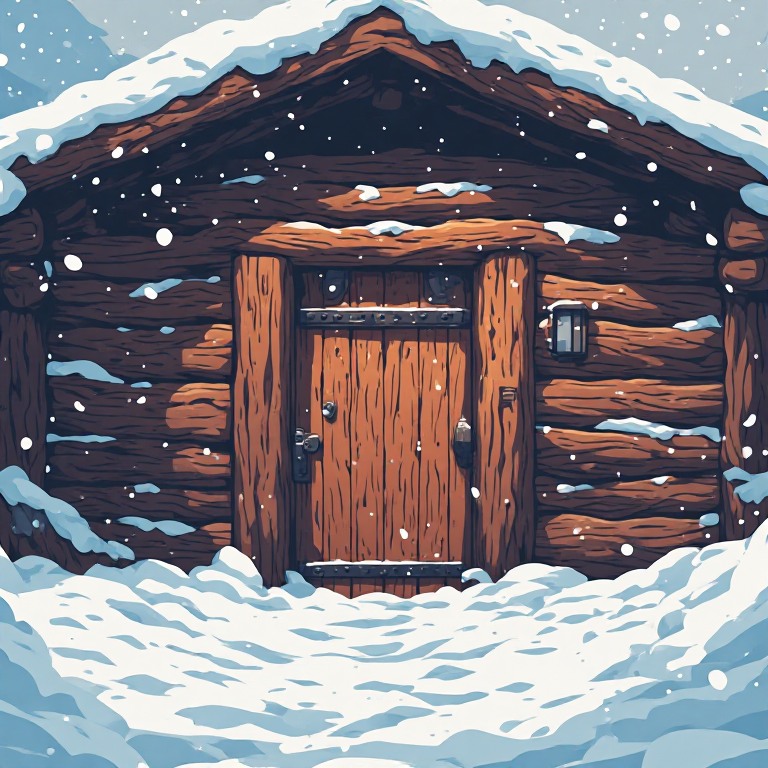
Right out of the gate, or the door frame as it were, the poem is talking about the door, or the door bar to be precise. The tree, tré. Every translated association with tré had one thing in common: they were tree-trunk shaped, from doorposts to humans to poles in the ground. To the Norse, if it was wood it was tré and that included the tree itself. (Cleasby, s.v. tré)3. I chose the more literal and poetic translation, being as this is poetry.
The door bar was how you locked a door way back when wolves were wolves and snow banks piled high. If it was especially long and heavy, someone moved it and later slid it home. Poetically the door bar usually rides high from the floor. Set it too low and it’s inconvenient to deal with. Set it too high and short people sigh and mutter. Set it in the right place and it’s easy to access while having more strength to hold the door. The right door bar can be made very strong, and probably very heavy.
Riða is a bit of a problem. The word also can mean “to swing”, but the only thing that swings in the doorframe are the wooden doors themselves (Cleasby, s.v. riða)4. The posts in the door frame that actually hold the door, also a type of tré, don’t move at all unless something has gone very wrong. The beam, on the other hand, is forced to take a trip each time the door is opened and closed. It might be the kind that swings upward. It might be the kind that slides back and forth. But it rides along as it does, and poetically that’s the point.
Therefore, the subject of the stanza is the door bar, and it’s a mighty wooden beast manhandled by the best of men who give it rides to and from its place wið the door.
Secondly, there’s the matter of giving the ring. Getting married? No. Okay, then who is it for?
Pettit and Crawford both feel the recipient is the guest who just walked past the door bar. By western thinking, it’s a logical conclusion. However, the stanza itself does not mention a guest at all, although stanza 135 does counsel on how to treat a guest properly. Larrington’s translation (2014, p. 31)5 takes a more reserved approach to the matter: “Give a ring, or there’ll be called down on you a curse in every limb.” And Sæmund in 1908 (p. 101)6 simply said it was men in general.
That there are humans involved in this stanza is apparently a bit of a debate. But first and foremost, the subject of this verse is the door bar. It makes literally no logical sense in any poem, much less the verse so skilled and exact as that written by a skald (bias aside), for the subject of a single stanza to shift so suddenly. These verses weren’t always written down. Many scholars feel the poems were performed orally.78 Today we understand the actual science behind why a close-up in film or why sequential art is framed the way it is on paper. The same must go to oral poetry.
Gold rings were not given lightly. Sheehan (2013) tells us, “The most important sources of relevance for Viking-Age gift giving are represented by the laws, sagas and skaldic poetry of Iceland and, to a lesser extent, Norway.”9 I’m sure it isn’t that bad, however my imagination runs wildly in this way: Give a ring else your guests will wish ill upon your joints would soon put any homestead into poverty when everyone in the countryside conveniently made detours for a handout. It sounds like highway extortion, when you think about it.
Then, is the ring a metaphor, some way of saying to give your guest a gift? Sæmund (1908, p. 101) says it means to “shower your wealth.” Pettit tells us to give a ring. Crawford says only to give something. But you already are sharing your warmth, your food, your ale or mead. You may even have thrown a hairy cloak over someone’s threadbare shoulders. In fact, it was expected a man would host well from his larders in them thar days. Therefore although the ring’s recipient isn’t clear to us, it’s generally agreed upon that this stanza means to be generous to your guests in some fashion.
I disagree. Here is why.
You could assume the Old Norse neuter þat, “that,” refers to the guests, yes. It’s logical to us. If someone visits and you fail hospitality, they might curse you. But what made me pause in my studies is that the subject isn’t a guest. It’s the door-bar.
If baug, “ring,” is not a material object or metaphor for a generic gift, we need to investigate another meaning of the word. This is not jewelry that is being given. It’s not monetary value. This is something else. So the next question: is it ring as in a parting gift, as in just a gift, or is it another kind of ring? The poem has already covered hospitality, that possibly rules out a gift exchange. This leaves it’s another type of ring. and once again the focus is on the door bar.
Did door bars get rings of any kind? A gold or copper band would be wasted on a door bar,. although an iron ring banded to it would reinforce it’s power but did it happen? It just so happens that evidence of Norse door construction suggests there were all sorts of rings involved (Morris, 2000)10. There were door rings for knocking, rings of wood, and leather around other parts to make them stronger. In Hávamál‘s case, the most important rings may be the ones given to door bars regularly even to this day: the retaining brackets, loops you slip the bar into when you lock the door. In Hedeby, a magnificently preserved door was found showing just such fittings. With this sort of door mechanism, you slide the door latch in place, and you’ll see what I mean. There are all kinds, and in all of them the bar be it large or small is fitted into something that surrounds it like a gift of love. Things don’t have to be perfectly circular to be a ring, at least not when there’s a metaphor on the line.
This suggests Stanza 136 is warning, “Shut and lock the door. Were you born in a barn?”
Could it be a guest who gets the ring, after all? Stanza 135 has already addressed the guest. It tells the listener (Loddfafnir) not to insult a visitor, drive someone away from the gate, or mistreat a person in need. Stanza 136’s syntax on the matter is decidedly neutral. It’s not aimed at a man, nor a woman. This matters.
A presumed male guest would use masculine words. The same rule goes for a female guest. Although proper English grammar would use the neutral ‘they’ for these unknowns here, Old Norse was more precise. Masculine pronouns were the default, just as it’s considered the correct default in modern English. The noun maðr, for example, could mean a person regardless of sex, and be followed by the masculine pronoun hann (Trond, 2006).11 But þat, the word used in this stanza, is neuter. The only neutral-gendered entity in the stanza is the bar, the very object the stanza starts with. This suggests that you give the bar the ring, and not a guest.
This by the way is one way animism works, which is why this stanza is a beautiful example of animistic thought layered in ancient poetry. The bar is a neuter item, yes, but it also has enough presence to be something you’d give to. If you didn’t you may suffer the consequences.
To the Western mind the guest is the sensible option. Give a ring to a bar? It’s a bar, for crying out loud! A couple of generations ago, it would have been absurd to consider the bar be treated as if it were a living person in the room. Animism as a viable worldview is still a relatively fresh idea in parts of academia. Even today, Barnes (2008, p. 263) tells us that animistic-sounding phrases like “be given well winds” is treated like idioms and not signals of cultural world thought.12 He considers the possibility that an unspecified power was understood to direct the wind, but cautions against treating the texts as proof of that belief.
I understand the caution. We should be careful about claiming we know exactly what every Old Norse speaker believed, but we should be equally careful not to rule out animism before examining the evidence. Many times people have made quick assumptions, and people believe those debunked assumptions today. But I also feel our treatment of words and phrases–all thoughts expressed by the skald– needs to acknowledge that these language artifacts point to a pool of worldview.
Then let us acknowledge that this is poetry from a day and age when kennings were king and abstract thought was the “ley” of the land. Even if the poet is not subconsciously giving that bar some sort of agency as one would, say Mjollnir in the naming of it there is a point to be made. If Old Norse allows for a gender neutral recognition that would involve a guest, there is still the art of the piece to be considered. That, too, has it’s own personal canon to be comprehended and possibly even overcome. In Old Norse poetry and literature, things have a certain agency.13 They get names. Things bring curses through your door. Here, it’s not a stretch that a thing can be given a ring.
To revisit my earlier point, consider how the stanza opens. That bar is strong. It rides. And the very opposite of what a bar does for the door is mentioned: the door is unlocked. The second half of the stanza is telling the listener, then, about the opposite of unlocked. Bar ride up, achievement unlocked. Give bar ring? Achievement locked.
So my second point is covered: the ring is given to the bar, and that ring isn’t a shiny armband. It’s the ring we give the bar when we lock the door, as well we should. Even Jesus probably knew that; he was a carpenter after all.
What happens if you don’t keep the door shut is, I feel, the most important part. The bar would wish læs upon you. Devillish dastardly læs. Such læs.
Yes, the usual translation for this word is “destruction” or “harm,” even “bane” if you’re feeling particularly Victorian. I chose “hollow” based on my research in which I am exploring an alternative understanding that includes the possibility of Indo-European world canon (Woþbora, 2026).14 If your joints are hollow, they ache. It sounds like arthritis, or perhaps the flu; even a cold. It’s aches and pains, but of the worst kind. Choose a more standardized translation, such as “destruction” or Crawford’s “harm”,.’ and the end result is the same: the bar, if left unlocked, will wish some sort of bad-spit-bad on your joints or limbs. It will still hurt.
And how do you get the dangerous ick in a cold and harsh place like Medieval or even Migration Period Scandinavia or Iceland? Why would your achy achy limbs hurt more than usual? You left the door open. You didn’t shut things up to keep your house nice, tight, warm, and take care of your homestead.
But the Germanic and Nordic people had no concept of arthritis, you say.
In Medieval ice cold weather, arthritis has concept of you. Hávamál is estimated to have been composed somewhere around 850 to 950 AD (Males, 2024)15. The famous Ice Age itself had long melted away, but the Little Ice Age (early 14th century to the mid-19th century)16 was hundreds of years away. In the meantime, the winters still sucked. They were harsh and long. They were also very cold, as winters tended to be back then.
Many afflicted people (my family included) will tell you that cold aggravates arthritis like Thor in a hall full of lustful Jotun17. Back in the cold old days, you didn’t necessarily know that your joints aching was because of some sort of genetic disease. You knew that your family was prone to it, though. You knew knuckle joints would swell with age. Your joints were going hollow, or the bar laid a curse of negligence on your hands, and it hurt.
Not to mention that if it wasn’t arthritis, the flu sucks in a way only it knows. So does a cold, or really anything else that makes you sick. Cold weather is the sick season. This has been a fact for mankind since winter was invented. How many of you have heard, “Get warmed up! You’ll catch your death!” This isn’t something that was invented in the 1950’s. This is folklore wisdom talking, and it’s got a history of people observing patterns behind it. You “catch” a “cold.” You get sick. You didn’t play around with getting sick back in the cold old days. You shut out the draft.
I believe that’s why læ was the exact word used in this stanza. The skald was, as skalds tend to do, being very clear on the consequences. Skalds were masters of their art for reasons.
As if to back up the thought, the poem in stanza 137 moves further into the home from the door. “I counsel you,” the poem carries forward, giving more health advice with a touch of spiritual defense for good measure in, “wheat against magic” (Crawford, 2025, 49, stz. 137)18. It’s a very logical progression, if you look at the entire sequence. In stanza 135, Loddfafnir is advised to treat guests well. In stanza 136, now that the guests have arrived, we step through the door where we are advised to shut it or we’ll make ourselves sick. In stanza 137, we’re given health advice of the mind, body and soul. But that’s just like Odin, if you think about it. The one-eyed wanderer has been a healer, a guest, and a host. These things are important to him for personal reasons.
So here is my third and final point: the bar is helping to protect your life and limbs. It’s very opinionated about it.
I have a confession to make: part of the reason why I’m able to accept readily that barring the door against the harsh elements is a natural given is because I grew up in harsh elements. I remember the winter of ’77 like it was yesterday1920— or rather, my toes remember because we couldn’t afford to get my young feet new shoes–as well as icicles from the trees and the crunch of frost on the ground when I headed for the bus stop21. And this was Florida! I’ve heard tales out of Chicago. Brr.
That Odin would come to someone’s hall and tell them to keep the door shut against the weather isn’t unreasonable. He tells you what beer to drink. He gives advice on fighting other men, on when to call a spade a spade (or rather, evil as evil), and even when not to talk to the unreasonable (Crawford, 2025, p. 46-49)22 (advice most of the internet could use). In fact, Odin covers so many aspects of the human condition it would be odd if he didn’t give advice on how to keep yourself warm in the winter.
That he treats the door bar as a living being is also not too far-fetched. Be it a queer habit of the poet or an artifact of a more ancient worldview, we’re looking at words penned from a completely different way of seeing the world. Most people in the West do not see the spirit in that door bar. An animist would, and animism is a Germanic ancient fact of life just the same as it is for other parts of the world.23 It’s not inconceivable, then, that the door bar would wish ill just as a ring was the future instrument of destruction to an entire family in Otrgjǫld. (Völsunga saga, ch. 14)24
However, that this is a stanza that begins with poetic verse with the tree riding unlocked, that the second half is not poetic verse would be ill-fitting. The two are served well by being a matching set rather than verse haphazardly put together. Any animism locked within has the ring of after thought, as if it was taken for granted.
After it all, when it comes to how we see the world — the very impressions in our culture and lives that color how we understand the universe — we really do take them for granted. We express such things without realizing it so that four hundred years from now, a new generation of people can read our verse and struggle to understand. They’ll debate about it. They may even gatekeep parts of it, sliding the bar high on the door and raising it when needed.
Perhaps we should remember how to heed Odin’s advice. Of course, we should. Keep winter out. Carefully put the latch in place against other dangers. But also, take care of our home. Maybe it’s not alive to you. Maybe, too, not letting the front door fall apart matters. It’s one of the few things standing between you and the harsh cold world.
- Jackson Crawford, trans. and ed., The Poetic Edda: Expanded Second Edition: Stories of the Norse Gods and Heroes (Indianapolis: Hackett Publishing Company, 2025), 49 ↩︎
- Edward Pettit, ed. and trans., The Poetic Edda: A Dual-Language Edition (Cambridge, UK: Open Book Publishers, 2023), 110–11. ↩︎
- Richard Cleasby, Guðbrandur Vigfússon, and William A. Craigie, An Icelandic-English Dictionary, 2nd ed. (Oxford: Clarendon Press, 1957), s.v. “tré.” ↩︎
- Richard Cleasby and Guðbrandur Vigfússon, An Icelandic-English Dictionary (Oxford: Clarendon Press, 1874), s.v. “ríða,” 498–99. ↩︎
- Carolyne Larrington, trans., The Poetic Edda, 2nd rev. ed. (Oxford: Oxford University Press, 2014), 31. ↩︎
- Olive Bray, trans. and ed., The Elder or Poetic Edda: Commonly Known as Sæmund’s Edda, Part I: The Mythological Poems, Viking Club Translation Series, vol. II (London: Viking Club, 1908), 101. ↩︎
- Ben Chennells, “Dual Identities and Double Scenes: Transformations of Physical Space and Mental State in Performances of Eddic Poetry,” Saga-Book 46 (2022): 31–64, especially 32–33. ↩︎
- Simon Nygaard, “…nú knáttu Óðin sjá: The Function of Hall-Based, Ritualised Performances of Old Norse Poetry in Pre-Christian Nordic Religion,” in The Fortified Viking Age: 36th Interdisciplinary Viking Symposium, ed. Jesper Hansen and Mette Bruus (Odense: Syddansk Universitetsforlag, 2018), 26–34. ↩︎
- Sheehan, John. “Viking Raiding, Gift-Exchange and Insular Metalwork in Norway.” Early Medieval Art and Archaeology in the Northern World: Studies in Honour of James Graham-Campbell, 2013. https://doi.org/10.1163/9789004534001_043. ↩︎
- Carole A. Morris. Craft, Industry and Everyday Life: Wood and Woodworking in Anglo-Scandinavian and Medieval York. 2002. ↩︎
- Trond Trosterud, “Gender Assignment in Old Norse,” Lingua 116 (2006): 1441–1463. ↩︎
- Michael Barnes’s A New Introduction to Old Norse, Part I: Grammar, third edition (2008), page 263. ↩︎
- Julie Lund, “Connectedness with Things: Animated Objects of Viking Age Scandinavia and Early Medieval Europe,” Archaeological Dialogues 24, no. 1 (2017): 89–108, https://doi.org/10.1017/S1380203817000058 ↩︎
- Woþbora, Filthy Læs (unpublished research, 2026). ↩︎
- The Dating of “Hávamál“. (2024). Maal og Minne, 116(1). https://doi.org/10.52145/mom.v116i1.2277 ↩︎
- MATTHEWS, J.A. and BRIFFA, K.R. (2005), THE ‘LITTLE ICE AGE’: RE-EVALUATION OF AN EVOLVING CONCEPT. Geografiska Annaler: Series A, Physical Geography, 87: 17-36. https://doi.org/10.1111/j.0435-3676.2005.00242.x ↩︎
- It doesn’t have to be true to be perceived that way. Any medical debate on whether cold actually makes joints hurt is for another paper. ↩︎
- Ibid. ↩︎
- U.S. Department of Agriculture, Florida Crop and Livestock Reporting Service, Florida Citrus Summary, 1977, “Florida Weather Highlights, Selected Areas and Months, 1976–77 Crop Year.” ↩︎
- Nick Petro, “Can It Snow in West Central Florida? A Look Back at the Freeze of January 18–20, 1977,” National Weather Service, Tampa Bay Area, 2008. ↩︎
- My father ran the sprinkler onto a big pine tree at night to keep the pipes from freezing. You’d wake up to a real winter wonderland that Narnia would have envied. ↩︎
- Ibid. ↩︎
- Lund, ibid. ↩︎
- Snorri Sturluson, Edda: Prologue and Gylfaginning, trans. Anthony Faulkes, Skáldskaparmál, ch. 39–40. ↩︎
Citation and Reuse
You have permission to cite and reproduce this article for noncommercial purposes, provided you credit the author and link back to this page. For commercial use, please contact me. I will generally be happy to grant permission.
This article is also available on [Academia.edu].
Suggested citation: Woþbora. “Hávamál 136 and the Case for Norse Animism.” The River Shaman, 2026. DOI: 10.17613/e3mne-v3852
.
Discover more from River Shaman
Subscribe to get the latest posts sent to your email.