Álfablót Without Blood
On November 6, I hope to hold my first little álfablót, or… well it’s going to be something. I was calling it álfablót but there’s also Vetrnætr, otherwise known as Winter Nights — the first of the primary Germanic holidays... It was a three day affair. For the Norse, these shindigs would start on Thor’s Day and always end on Loki’s Day. Loður’s Day. Whatever. One, the other… maybe I’m celebrating Vetrnaetr. I would do it all three days, and perhaps I’ll find a way to do something small being as I’ll be by myself. Either way I’d chosen that time because research—sources put it near the end of October or beginning of November, after harvest, when animals were fat and the doors were shutting against winter. Afterward I will probably take down the vé tent, clean up the area, and move my ritual activities indoors such as they are.
I work with the spirits frequently, so logically I thought that for this special occasion I should do things a little differently. Naturally this means I asked others who are supposed to know. Some responses were simple likes and one care emoji. There were a couple of attempts to understand what I was saying (I’m not very good at expressing things at times.) and give good answers. Other responses were laced with ignorance or snot from a high tower. “Why are you holding for the elves and not the gods???” And, my favorite, having my post removed entirely.
One of the most popular blogs for heathenry – the religion with homework some have called it – likes to postulate about when things are to be held, what the proper calendar is, and other hoity-toity terms and dates that may or may not be important to laymen like ourselves. I do read it when a new post comes up, but usually I end up drooling on myself a little. If a certain Norse expert can leave academia because he felt like the other scholars were only talking to each other in their “ivory towers”, and I can decide not to pursue a PhD partially because of the politics and attitude held by other scholars, then perhaps centering an important path of information that you’re releasing to the masses shouldn’t just talk to other people in their ivory towers. It’s okay to use common language, people. It’s okay to answer that post, even if it’s just to a link on an article with good information.
But I digress.
I don’t kill animals, although if you give me the right knife and some time I might be able to remember how to behead and descale a fish. (I AM river folk, after all. Yes, I *can* weave TYVM.) Part of it is that I’m under a personal oath that I’ve held my entire life since I was small. Another part of it is that I’m fundamentally kind, I guess. Maybe. There’s just this thing inside of me, and it’s a big red wall of no. Even though I like steak.
It also has to do with my path, that of purification. Blood is important for some sacrifice: I’m not going to argue that. But I’ve always viewed blood in the use of purifying spiritually as the wrong approach. I see it as unclean. It turns out that history backs me up a little. In Greece (and possibly Rome), blood was thought to carry miasma – negative spiritual residue – and to spill blood in a temple was a high offense to the gods. It would pollute the sacred space. There’s even a famous (Roman) story about a priest spilling his own blood in Jupiter’s temple as a curse
For the Norse this was sometimes the case as well. Freyr, god of fertility and the field (among other things), may not take it kindly if you spilled blood on his corn. I’m not going to go into the Aztecs and their sacrificial habits, but I will gently point out there were more people in that region than the Aztecs.
To continue this digression, the thing that’s been nagging me about it is how everyone is so centered on the bloodletting that they’ve taken it to exaggerated levels. Meanwhile, the whispers in my mind – the ones that may come from ancestral memory, family activity, or manga-inspired insanity – whispered the words “blood of the earth” so much I ended up doing a dig dive and discovering red ochre, the pigment used in watercolors. I also learned that old remnants of holy areas and some burials used red ochre to color things. To redden the poles, so to speak. On an academic level, this has me poking at theory to see if anyone else has wondered if the bloodletting replaced the use of red ochre.
Anyway. For many, the blóts are all about that ritual sacrifice: that killing of the animal. It’s supposed to be a sacred thing, the taking of this life to feed the masses and give to the gods. The point of sacrifice is to put an energetic balance back into the world – and I hope to dedicate an entire blog post to that in the future. Someday. For this holiday, though, there’s a problem if the forces are expecting me to draw blood. For me personally, it goes against my path. And I think there are too many who don’t understand it. I’ve met some main drive to do this thing was for the sake of killing. This is the biggest reason, for me, why shedding blood for purification purposes is wrong. That’s about as unbalanced as you can get.
Let me say that again for those in the back: the biggest blót have sacrifice, yes—but the spine of it is giving and sharing, not the thrill of the knife. I don’t kill. I have oaths. I have a temperament. I have lines I won’t cross (for now). And I’ve met folks whose “piety” is really a hunger to do violence dressed up as religion. If your heart is set on blood for blood’s sake, that’s not holiness. That’s an imbalance.
(Author’s addendum 5/20/26: since writing this post, I came to realize what the spirits were guiding me for was traditional shamanism while I still research Norse and Germanic lore, history and language. And it turns out that in the shaman lineage I found, blood sacrifice is a MAJOR taboo… except on one rare occasion. So my instincts were correct!)
The Álfablót
Sigvatr Þórðarson, skald to bloody King Óláfr Haraldsson (St. Olaf), tells us he was turned away at Swedish farm doors in late autumn because the household was holding álfablót. The housewife called it holy and said strangers could not enter, invoking fear of Óðinn’s wrath if she let him in. That gives us the frame: private, household, late autumn, doors shut, outsiders excluded.
Réðk til Hofs at hœfa; hurð vas aptr, en ek spurðumk
(inn settak nef nenninn) niðrlútr fyrir útan;
orð gatk fæst af fyrðum, (flögð baðk) en þau sögðu,
hnekðumk heiðnir rekkar, heilagt (við þau deila).Gakkat inn, kvað ekkja, armi drengr, in lengra;
hræðumk ek við Óðins (erum heiðin vér) reiði;
rýgr kvazk inni eiga óþekk sús mér
hnekði alfa blót sem ulfi ótvín í bœ sínum.Nú hafa hnekt, þeis hnakka (heinflets) við mér,
settu (þeygi bella þollar) þrír samnafnar (tíri);
þó séumk hitt, at hlœðir hafskíðs myni síðan,
út hverr’s Ölvir heitir, alls mest, reka gesti.1
- I turned toward Hof to seek lodging; the door was closed, and I asked, stooping outside; I got few words from the people—heathen men pushed me away: “It is holy.”
- “Do not go in,” said a widow, “unlucky man, any farther; we are afraid of Odin’s wrath; we are heathen.” The woman said she had inside the álfablót; she drove me away from her farm like a wolf.
- “Now they have driven me away—those who put their heads by the threshold—three of the same name; and I think that every man called Ölvir is most of all one to drive out guests.”
I honestly think that why the door got slammed wasn’t because álfablót turns folks mean. It’s because of who was knocking. Just look at what the widow said to him! Sigvatr wasn’t just some dusty traveler—he was the king’s own skald. And not just any king, either: Óláfr Haraldsson, the fella who made “convert or else” a lifestyle. Folks knew his kind rode in with crosses in one hand and torches in the other. I imagine the moment he got off the boat to scout the land, there were whispers ahead of him. “The skald is coming!” Then he shows up at someone’s door during the holy season. If you see a man who sings for that king at your door, you don’t invite him in to sniff around your business. You shut the door and you make it real clear he ain’t welcome.
If the stranger had been a fellow heathen, the door still would’ve stayed shut. The conversation tone might have been more like: “Evenin’, friend. Can’t let you in—holy night.” “Oh, so it’s everywhere tonight?” “Yep. Swing by later.” “Fair enough.”
While I pondered this, my spirit friend showed me something else. Hospitality wasn’t just a rule but a Thing, and they wouldn’t send him off empty‑handed. “Hold up—take this for the road.” A meal cake would be passed through the door. I saw it clear and plain, on a scrap of red leather or something. Round, with seeds on the top. Rough looking. Sort of like unappetizing cornbread.
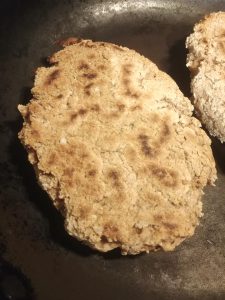
That’s meal cake?? I looked it up, and sure enough, that was meal cake. The gift of the cake was nesti, journey‑provisions you hand a traveler when you can’t host. I didn’t know about nesti, but I do now2. I didn’t know that meal cake was actually a type of cake, but I do now.
What do we know of álfablót? Beyond “family‑only and holy,” we’ve got: the when (late autumn, after harvest); the where (at home, not a public hof); the who (the household, with the woman of the house possibly conducting the rituals); and the who‑for (the álfar… ancestors, guys. You were honoring your ancestors.). The how is the part we don’t get; secrecy was the point. So: time, place, audience, and gatekeeper we have. The rest? Kept quiet. Aaaand that’s about it.
I’ll add another human observation. Families have traditions. Thanksgiving, Christmas… Easter… Every household has its own way of doing things. It’s nonsense to imagine álfablót was so amazing that every farm did it identically. The sources themselves imply the opposite: secrecy, household control, variation.
I guess this leaves me free to make up my own damn blót, for all I was hoping to learn from others who had been heathens longer. Which means I’ll be asking my spirit spouse about it when the times comes. Or I’ll do like I always do, which is to go through whatever motions work at the time. I’m a freeflow wyrd worker, not always by choice.
Vetrnætr
The Álfablót is the private heart of the Vetrnætr, or Winter Nights. Winter Nights is the season for setting the year right, and the Álfablót is the rite aimed at the kin under your turf and the land-neighbors who actually make that “good year” happen. There are two major expressions of the same core idea: the Norse Dísablót and the Anglo-Saxon Modraniht, held on the longest night of the year which is generally Christmas Eve.. The timing shifts, but the job doesn’t.
In De temporum ratione, Bede writes regarding the Anglo-Saxons:
Incipiebant autem annum ab octavo Calendarum Januariarum die, ubi nunc natale Domini celebramus. Et ipsam noctem nunc nobis sacrosanctam, tunc gentili vocabulo Modranicht, id est, matrum noctem appellabant: ob causam et suspicamur ceremoniarum, quas in ea pervigiles agebant.[3]
“They began the year from the eighth day before the Kalends of January [Dec. 25], where we now celebrate the birth of the Lord. And that very night, now most sacred to us, they then called by the pagan name Modranicht, that is, ‘night of the mothers,’ we suspect on account of the ceremonies which they performed, keeping watch all through it.”
Modraniht honored the ancestors, especially the mothers, with what sounds like an all night vigil. But what were those “ceremonies”? Were there gifts? Part of the answer is in the folk tales. We see it plain as day in the stories of Askeladden3, where you left an offering of porridge with a pat of butter. I can tell you from amusing experience my spirit spouse still treasures that butter. If you didn’t make the offering, you could expect curdled cream and unhappy livestock.
That tradition was everywhere. Across the North Sea, the Scottish Brownie got his bowl of cream. In parts of England, it was the Hobgoblin or Hob who lived by the hearth and expected his nightly bowl of milk to keep him from turning mischievous. The German Kobold did chores in exchange for his share. You feed the house spirits, the vættnir, your household neighbors.
We have to make a distinction here, lest the names get tangled. The Hobgoblin isn’t one thing; the name itself tells you it’s two.
The “Hob” is the hearth-spirit. He’s the Brownie, the Nisse. If you like you can see him as the Loke-spind—the daddy long legs. He’s part of the house, a bit of a trickster, but he’s the one who eats the real pests, the attercops that I’ve mentioned in the past. Offerings of milk and porridge are for him; they’re the payment that keeps him on your side. He’s part of the household ecosystem.
The “goblin” part is the attercop—the poisonous, spindly black motherfucker. That’s the outsider, the monster you ward against with iron and salt. Charms in a pinch. There’s no bargain with that one; it’s a predator, plain and simple. They aren’t the house-wight having a bad day (although lately I can tell you that you might wonder); they’re a different class of being entirely.
Moving along. The Norse equivalent of Mōdraniht was likely hǫkunátt. We aren’t sure anymore what the name means (scholars guess everything from “slaughter-night” to “mound-night”), but this was the night the Wild Hunt rode. You stayed safe inside with your kin. This is when the dísablót was performed. It honored the powerful, female dísir and was held during Winter Nights, and again for some at the vernal equinox.
I reiterate that the point was to honor the ancestors—or the dísir as ancestors, that part’s murky—and call in a good harvest. It was such an important time of the year, you could set your calendar by it. The family sagas live in this season. Heimskringla’s Hákonar saga góða talks about ale being brought in, proper toasts going round, kettles humming over the hearth, and—if there’s slaughter—the hlaut‑blood collected and flicked about with a twig, as if the gods appreciate good interior decorating. Gísla saga Súrssonar turns plot on a vetrnætr feast at a chieftain’s place—because everyone knows that’s when households host and “come back tomorrow” isn’t rude, it’s policy. Eyrbyggja saga gives us local feasts, local gods, the blót waiting where it always waits. Grettis saga and friends use “at vetrnætur” like we’d say “at Christmas” or “on New Year’s.” When a text says “at vetrnætur,” you’re meant to picture the three‑night winter turn. Even the laws get in on it. Grágás uses Winter Nights as a deadline, which is how you know it mattered: if lawyers can schedule around it, it’s real.
We don’t have a step‑by‑step for the private household. That’s fine. The bones are there: shut door, set table, pour first, share fair, speak names, let the night take the shape it wants. Follow that, and you can taste álfablót.
Blotting it Out
“At winter‑nights men sacrificed for a good year.” — Ynglinga saga (Heimskringla)
When the sources actually describe how the more communal blót works, there is talk of ale brought in, formal toasts, shared feast—and, when there is slaughter, ritual handling of blood in a hlaut‑bowl with a sprinkling twig – Oðin’s wonder wands.
“It was the old law that, when there were to be sacrifices, all the farmers should come to the temple and bring their own ale.”
“All kinds of cattle and horses were slaughtered… the blood was called hlaut; the vessels were hlaut‑bowls, and the sprinkling twigs hlaut‑teinar. With these they sprinkled the pedestals of the idols, the walls of the temple within and without, and also the people present.”
“The flesh of the slaughtered cattle was cooked… fires were made in the middle of the floor, and kettles hung over them… and there were formal toasts: the first to Odin for victory and power for the king; then to Njǫrðr and Freyr for peace and good seasons; then the bragarfull/king’s toast.”4
There’s also a churchman’s gore‑happy account (Adam of Bremen) in Gesta Hammaburgensis IV. 26–27. In Uppsala every ninth year victims were offered, and the grove was soaked in blood with bodies displayed. But that was alright because there was lots of feasting/drinking. If it’s okay with the spirits – and I promise it is – my little grove already has a pet graveyard. I’d like it not to go farther than that.
For a more modern take, there’s also a book I have on the shelf, A Modern Guide to Heathenry (Krasskova). There are also various posts online – most of which talk to their reader as if there is, in fact, no ivory tower.
Steps of a blot:
- Folks gather with various foodstuffs potluck style, and the space is hallowed. That’s easy for me: I keep my space hallowed. I’m in a temple/spirit space after all. I’m a grove goon.
- There will be offerings, usually in wine, ale, or food.
- There will be an invocation and prayer (usually to the gods). My drive is to return the connection to the land, and as this is álfablót… I’ll probably lay out the offerings, yell “come and git it!” and purify/bless the fare. Yes. If you piss me off, I really will yell, “Come and git it!” – and I guarantee the spirits will not be half as insulted as the humans who hear it will want them to be. This is my blót, and I can be friendly and treat the spirits like family if I want to.
- In the bigger blóts apparently there’s the passing of the horn after. And talk, trading of stories, and an over-ritualized caricature of people hanging out and having a good time, it almost seems. I do agree with the passing of the horn. I don’t agree with forcing interactions into a straight jacket when in the old days these interactions happened because the ancestors didn’t have a television to distract them from being in the moment. But I’ve only been to bardics where people sat around the fire and had a good time, not a ritualized space like that. So I can’t say one way or the other.
- This is when the feast happens…?
- And then you end feast on the nose with a closing ritual – THIS FEELS SO WRONG TO ME!!! Ahem. I mean, I get it. You must close the space. And some holding their ritual may have borrowed the space (like a park). But my mind is filled with images of the celebration going on in the night, and those that couldn’t stay awake passing out and others sitting quietly at the table. And… I’ll support you if it’s your own way and I’m a guest, but for me and mine? It feels unnatural. It doesn’t feel human. I suspect that’s the wild magic in me.
Let Us Eat Cake
So I don’t know what I’ll be doing exactly, but I do know this: for my sacrifice, cake is the answer.5 Or it might be one part of an answer. Spirit spouse bless my spirit spouse for bringing it up.
Cake offerings are a modern reconstruction, but they aren’t modern fluff. The Anglo-Saxon calendar calls February Solmōnaþ (the “month of cakes”). That’s a whole month that would have made Marie Antoinette proud. Yet there’s no evidence to this date that cakes were offered to the spirits during Winter Nights. But worry not my wightlings, we DO have actual offerings mentioned in folklore. It’s the porridge with butter for the nisse, the bowl of cream for the Brownie.
Milk, cream, and butter.
So, why these things? And don’t just say it’s ‘farm bounty’—that’s lazy, and plenty of people didn’t live on farms.
It’s because milk is super powerful. More powerful than blood, I suspect. It’s a life-giving force produced through the circle of life, weaving itself within in ways blood doesn’t do. It provides precious antibodies to small infants. It feeds the youth until they’re ready to eat on their own. It builds a healthy body with strong bones. It can even contain blood, to really get that extra whammy in. The by-products – the cream and most especially the butter – are infused with human effort when created the old way.
But the most important part is what it is: a mother’s gift. When an infant feeds from their mother’s breast, they look up into her eyes instinctively. A good mother smiles down, and the circle expands into the connectivity of human to human and later to the natural world. So on Mother’s Night, what’s the most powerful offering you can make? You’re giving the ultimate mother’s gift back to the ancestral Mothers. It’s not just an offering of food; it’s an offering of life, protection, and kinship, all in one bowl. The spirits know it, as do the gods.
There’s also that the offering was always meant to be the “best of the house.” That’s why the butter was so important—it was a sign of wealth and generosity. Adding honey would be the ultimate way to enrich the offering. The phrase “a land flowing with milk and honey” hearkens to the Promised Land, a paradise of divine blessing and impossible abundance. But it’s much older and wider than that. In Greek mythology Zeus was nursed by the goat Amalthea, then fed honey by sacred bees. The food of the gods themselves, ambrosia and nectar, were often described as being honey-based. In the Celtic Otherworld (the land of the gods and fae) there where rivers of mead (made from honey) or milk flowing freely.
When I first began my modern practice, the internet told me to offer Frigg a cup of milk with a drop of honey now and again. She seemed to received it very well, especially when I made it into a smoothie and invited her to sup with me. But is there anything that says, “Frigg demands a latte with extra honey”? No. But the symbolic connection is strong. Milk is her domain by definition, for she is the All-Mother that reigns over childbirth and the household. And when it comes to honey, it’s all over the place with the gods drinking their mead to the honeydew the bees harvest from Yggdrasil to make it.
While the Nisse gets his buttered porridge, offerings to higher-status beings often included honey. The German traditions collected by Jacob Grimm are full of accounts of leaving out special honey-sweetened breads (Honigkuchen) and other foods for spirits like Holda or Frau Holle, who is widely seen as a survival of Frigg. Offerings of food, especially special breads and porridges (which would be sweetened with honey), were left for her during the Yule season.
The old traditional gift of porridge with that pat of butter, or just a bowl of warm milk the cats will find later, is the perfect offering. It bridges the worlds and, as is argued with blood sacrifice, gives back both the life they passed down to you and the sacred essence of the halls they now inhabit. When you add honey, you’re elevating the offering to a gift fit for the gods. You are combining the substance of earthly motherhood (milk) with the substance of divine paradise (honey).
Honeyed Words
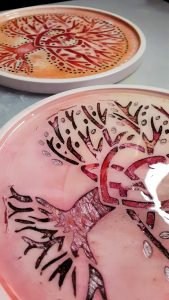
For álfablót/Winter Nights, honey-sweetened cake, milk, and possibly porridge is my currency. I happen to know how to make butter from cream. If I can get my hands on raw milk from one of the local providers, that will be more appropriate than if I just buy it from the store. My spirit spouse showed me that little round on a scrap of leather, and it fits the old way two different directions: nesti for a traveler when you can’t host; and a first‑fruits style gift for the elves who share the land with my line. I’m so fortunate I’d heard many times over about leaving milk out for the little people growing up as well. I make offering plates for sale. I can use one of those. My spirits will be fat by the time I’m done. Fat, fat, fat.
And since folks will ask “okay, how do we make a meal cake?” this isn’t a cooking blog. My snackrifice-loving spirit spouse likes all things vanilla, and I’m fond of maple… so perhaps I’ll make Narragansett bread. It’ll be holy, and special, however things happen.
Oh. A ham would be lovely. (Another edit: I couldn’t afford one, and it turns out certain meats are also taboo as offerings.)
Sigh… still have to get the plumbing fixed… but I digress again.
That’s it. Family rite. Honest gifts. Shared feast. Cake on the threshold for the road if someone friendly shows up on the wrong night. It keeps both laws at once: the holiness inside, and the honor of the house at the door.
****
For further reading, be sure to check out the scant but growing associated page here on the blog. If I kept the link to the papers, they will be there. And if you liked this, please share and subscribe. Tell me what you did for Alfablot, or if you did something else.
- Source: Skaldic Poetry of the Scandinavian Middle Ages, “Sigvatr Þórðarson, Austrfararvísur” (critical edition of the Old Norse text). ↩︎
- You can bet I’ll forget the word in an hour. ↩︎
- Heimskringla I, Hákonar saga góða, chs. 14–18 ↩︎
Discover more from River Shaman
Subscribe to get the latest posts sent to your email.